
Epithema
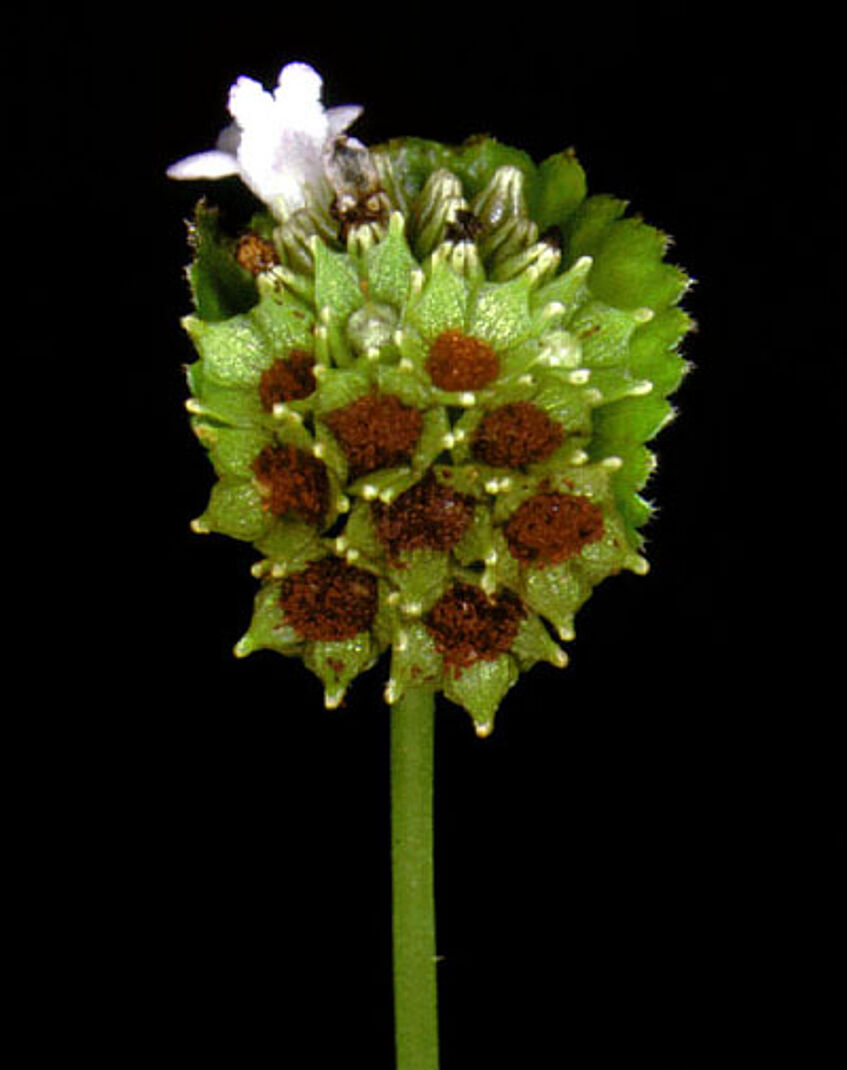
Epithema saxatile Blume, type species
Penins. Malaysia, Pahang, Bkt. Charas, phot. A. Weber (1984)

Epithema saxatile Blume, type species
Penins. Malaysia, Pahang, Bkt. Charas, phot. A. Weber (1984)

Epithema brunonis Wall.
Wall., Pl. Asiat. rar., t. 288 (1832)

Epithema carnosum C.B.Clarke
C.B.Clarke, Commelyn. Cyrtandr. Beng., t. 90 (1874)

Epithema ceylanica Wight
Wight, Icon. Pl. Ind. Orient., t. 1354 (1848)

Epithema madulidii B.L.Burtt
Philippines, Palawan, El Nido, phot. U.Ferreras (2008)

Epithema madulidii B.L.Burtt
Philippines, Palawan, El Nido, phot. U.Ferreras (2008)

Epithema parvibracteatum B.L.Burtt
Penins. Malaysia, Selangor, Batu Caves, phot. A. Weber (1984)

Epithema sp., diagrams of inflorescence and flowering plant; a Condensed pair-flowered cincinnus (with each cyme unit consisting of terminal flower – T and front flower – V) subtended by a bract (B); b Plant architecture: Hy hypocotyl, mCo Microcotyledon, MCo Macrocotyledon (both withered at flowering stage), Ep epicotyl, B3 solitary leaf, B4, B5 opposite leaves, each with axillary inflorescence, terminal inflorescence in between. From Weber (1976), Fig. 9.

Epithema cf. carnosum, inflorescence: pair-flowered cincinnus (with 4 rows of flowers) is embraced by a cucullate bract born on top of the stalk. From Weber (1976), Fig. 6.

Epithema cf. carnosum; uppermost (youngest) part of the pair-flowered cincinnus; note four rows of flower buds in different developmental stages.
Epithema
Full name and orig. publication: Epithema Blume, Bijdr. Fl. Nederl. Ind. 737 (July-Dec. 1826).
Etymology: From the Greek έπιθεμα, epithema = lid, cover, crown, wreath, referring to the fruit, a pyxidium opening by a lid.
Synonyms: Carpocalymna Zipp. (1829), Aikinia R.Br. (1832) – non Wall. (1832).
Infrafamilial position: Didymocarpoideae-Epithemateae-Epitheminae (Weber et al. 2013).
Description (from Bransgrove & Middleton 2015, slightly modified): Caulescent or acaulescent herb, occasionally only one leaf developing. Lowest cauline leaf petiolate and solitary, upper leaves petiolate or sessile, opposite or (rarely) alternate; blades thinly to thickly membranous, usually ovate to cordate, more rarely elliptic to orbicular, if asymmetrical then the wider side up to 1.75 times as wide as the narrower side, apex rounded to acute, base mostly cordate or sub-auriculate to obtuse, inserted evenly or unevenly on petiole, margin entire to crenate, serrate or (bi-)dentate, venation pinnate, upper surface pale to black-green, sometimes variegated, lower surface light to mid or olive-green or purplish. Inflorescences 1–15 (‒many) per plant; peduncles usually originating from the leaf axils, occasionally from the petiole and/or the midrib of the blade; singular bract subtending each inflorescence, cucullate and enclosing the entire inflorescence to reduced, margin entire to dentate. Calyx cylindrical to campanulate, consisting of a tube and 5 lobes, with an embedded gland towards the apex of each lobe. Corolla tube usually white, lobes pale pink to blue or purple, commonly with darker markings on either lip; tube cylindrical to narrowly fluted, occasionally slightly constricted at the apex; lobes with margins entire to fimbriate. Stamens and staminodes inserted on top of flap of androecial tissue which is inserted in corolla tube; fertile stamens 2; anthers coherent at thecae tips or along entire thecae; staminodes 2, third staminode absent. Nectary apparently absent or one- to three-lobed, margin entire to undulate. Ovary cylindrical to spherical, glabrous to densely pubescent, unilocular, placentation parietal; style short; stigma bi-lobed, papillate, glabrous. Fruit (sub-) cylindrical to (sub-)spherical; operculum circumscissile or irregularly dehiscing at maturity, indumentum as ovary; surrounded by persistent calyx. Seed usually narrowly ovoid to broadly ovoid, ends acute and/or constricted, light to dark brown with darker ends, pattern straight to spiralled, walls of pattern usually splitting and merging and with cross-walls, occasionally walls of pattern appear thickened and rigid.
Chromosome number: 2n = 16, 18, 24.
Species number: 20 (Bransgrove & Middleton 2015).
Species names (given only in case of few species).
Type species: Epithema saxatile Blume
Distribution: Central tropical Africa (E. tenue C.B.Clarke), India, Sri Lanka, Nepal, southern China, and through Southeast Asia and Malesia to the Solomon Islands.
Ecology: On humid or wet limestone (less commonly on granite or quartzitic) rocks, in forest, at cave entrances etc.
Notes:
(1) The genus occupies a rather isolated position within tribe Epithemateae and – also based on molecular data (Mayer et al. 2003) – has been accommodated in a subtribe of its own (Weber & al. 2013).
(2) Epithema has been recently revised by Bransgrove & Middleton (2015), who recognised 20 species. From the many varieties that have been published, the authors raised two to species rank and synonymized the others with their respective species.
(3) Epithema has a wide distribution, ranging from tropical Africa through S and SE Asia through Malesia to the Solomon Islands. Remarkable is the presence in Africa, with the single species (E. tenue C.B.Clarke) being the only representative of Epithemateae on that continent. The distribution is wide: W and E Africa, with a large gap in the Democratic Republic of Kongo.
(4) Epithema plants are ecologically flexible, growing well under everwet and seasonal conditions. Plant development, without or with interruption through a dry season has been described by Hallé & Delmotte 1973).
(5) Epithema reveals an unusual architecture of the plant body and the inflorescences. The two cotyledons develop extremely unequally, with one – the macrocotyledon – growing to a large, basal and seemingly solitary leaf. During or after withering of the macrocotyledon a truly solitary large leaf develops. This is usually followed by one or several leaf pairs. Inflorescences are produced in greater number both in terminal, axillary and extra-axillary positions. They consist of a stalk and a single, small or large cucullate bract and a dense axillary flowers head (condensed pair-flowered cincinnus without bracteoles) (Weber 1976, 1988). The flowers are short-tubed and funnel-shaped, details and development have been described by Weber 1976). Remarkable are the fruits: capsules with circumscissile dehiscence. The seeds get exposed through discard of the upper capsule part (operculum). Through re-opening of the calyx a perfect splash-capsule is brought about. Seed dispersal is clearly by rain.
Selected references: Hallé & Delmotte, Adansonia 13: 273-287 (1973), morph. & ecol.; Weber, Pl. Syst. Evol. 126: 287-322 (1976), morph.; Weber, Beitr. Biol. Pflanzen 63: 431-451 (1988), morph.; Hilliard & Burtt, Edinburgh J. Bot. 54: 111-113 (1997), new spp; Wang et al. in Wu & Raven (eds.), Fl. China 18: 400 (1998) reg. rev.; Hilliard, in Grierson & Long, Fl. Bhutan 2(3): 1328-1330 (2001), reg. rev.; Burtt, Thai Forest Bull. (Botany) 29: 81-109 (2001), annot. checklist (Thailand); Mayer, Möller, Perret, Weber, Amer. J. Bot. 90(2): 321-329 (2003), molec. syst.; Bransgrove & Middleton, Gard. Bull. Singapore 67(1): 159–229 (2015), rev.
Tax. details, cytology, and bibliography: Gesneriaceae Resource Centre (GRC). Royal Botanic Garden Edinburgh.
Page content and update responsibility/contact: Anton Weber.
Last update: